


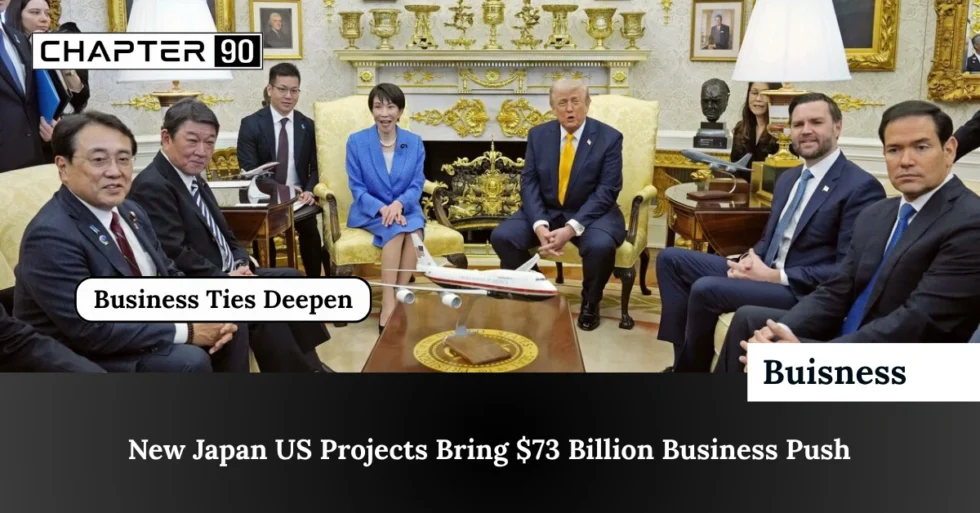
Japan and US Unveil New $73 Billion Projects to Deepen Business Ties
Japan and the United States have unveiled three new business projects worth about $73 billion in total, giving fresh momentum to their economic partnership at a time of energy pressure and supply chain risk. The projects focus on small modular nuclear reactors and gas fired power generation in key US states, with both governments presenting the deals as part of a wider push to strengthen energy security and support long term industrial growth.
Energy Projects Sit at the Center of the New Package
The new package is heavily focused on energy. The biggest project is a $40 billion plan to build small modular nuclear reactors in Tennessee and Alabama. The other two projects are gas fired power plants worth $17 billion in Pennsylvania and $16 billion in Texas. Together, they show how the partnership is leaning toward large scale energy infrastructure rather than short term trade symbolism.
The Investment Supports US Power Demand
The timing matters because energy demand in the United States is rising, especially from data centers and industrial activity. These projects are meant to support more stable electricity supply while also helping manage longer term energy costs. That gives the announcement a stronger business angle than a normal diplomatic headline.
Japan Is Expanding Its US Economic Role
The new projects are part of a broader Japanese commitment to invest in strategic US industries. Reuters reported that this round belongs to the second phase of a much larger $550 billion investment pledge. That makes the announcement important not only for the energy sector, but also for the wider direction of Japan-US business cooperation.
The Projects Also Reflect Supply Chain Strategy
Alongside the business projects, both countries also announced a joint action plan on critical minerals and rare earths. That plan is aimed at reducing supply chain vulnerability and supporting more secure access to strategic materials. In practical terms, it shows the partnership is expanding beyond single projects and moving toward a broader industrial strategy.
Business Value Goes Beyond the Headline Number
The $73 billion figure is large, but the real significance lies in where the money is being directed. Nuclear power, gas generation, and critical minerals are all areas tied closely to future manufacturing strength, energy reliability, and technology growth. That means the package could have a longer business impact than a one off investment announcement. This is an editorial inference based on the sectors named in the deal package.
The Focus Now Shifts to Delivery
The main question now is execution. Large cross border projects often face delays, financing challenges, and political scrutiny once construction and contracts begin. If these projects move ahead on schedule, they could become one of the biggest recent examples of Japan-US business coordination in strategic industries. This is an editorial inference based on the scale and structure of the announced projects.