


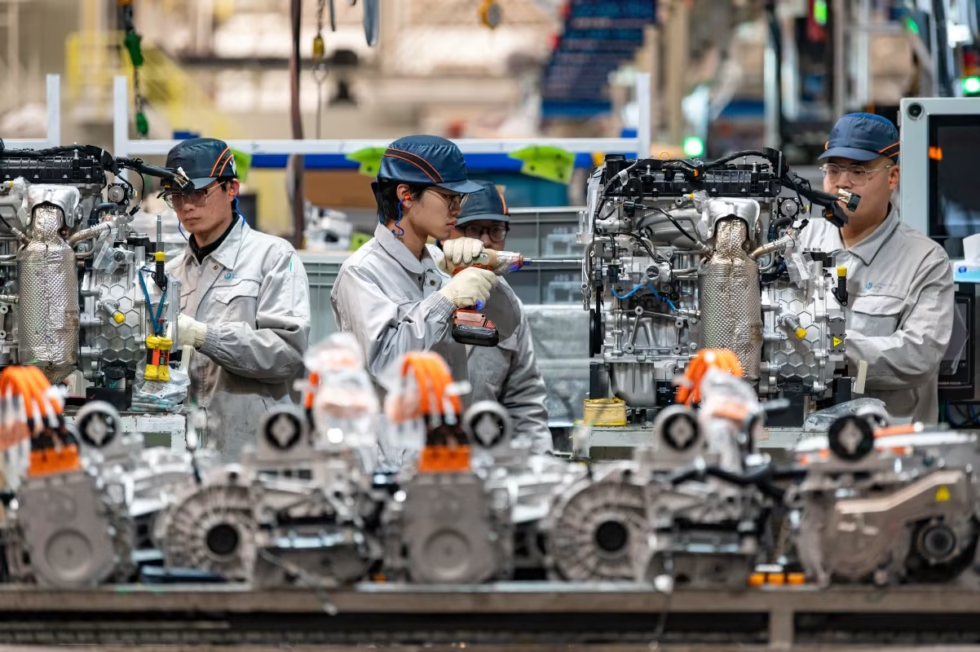
A record trade surplus is more than an economic milestone for China it’s a psychological statement. It suggests resilience, adaptability, and a growing belief that dependence on any single market is no longer necessary. But when success becomes visible, it also invites a harder question: how long can momentum last once expectations shift?
From a human-behaviour perspective, this moment reflects confidence built through repetition. Over time, China has adjusted supply chains, expanded trade relationships, and reduced exposure to geopolitical pressure. Each successful pivot reinforced the belief that diversification works. Confidence compounds until it is tested.
Trade surpluses don’t just measure exports and imports; they reflect collective behavior. Manufacturers invest because demand feels reliable. Policymakers double down because strategies appear validated. Businesses grow bolder when previous risks paid off. But success can subtly change behavior in ways that create new vulnerabilities.
One challenge lies in perception. When a country demonstrates it can thrive without a major trading partner, it reshapes how others respond. Competitors may harden policies. Partners may renegotiate terms. Markets may begin to expect continued outperformance rather than resilience alone. The emotional environment changes from survival to scrutiny.
Human behavior under scrutiny tends to shift. Decision-makers become more cautious, more defensive, or sometimes overconfident. The risk is not external pressure alone it’s internal expectation. Maintaining a “winning streak” requires discipline when the adrenaline of proving independence fades.
There’s also the issue of demand psychology. Trade success depends not just on capacity, but on global appetite. If growth slows elsewhere, export-heavy economies feel it first. Even strong systems are sensitive to collective hesitation among buyers, investors, and consumers.
China’s current position reflects strategic patience paying off. But patience is hardest to maintain after success. The instinct to protect gains can conflict with the need to keep evolving. Human systems often struggle here holding onto what worked yesterday while needing to prepare for tomorrow.
Another layer is narrative. Success stories attract attention, and attention amplifies pressure. The more China’s trade resilience is framed as proof of independence, the more markets will watch for signs of weakness. Confidence becomes fragile when it must be constantly defended.
In the end, this moment is less about whether China can trade without the US that question appears largely answered. The real test now is behavioral: can policymakers, businesses, and markets resist complacency and continue adapting in an environment where expectations are higher than ever?
Winning once builds belief. Winning repeatedly requires restraint. And in global trade, restraint is often harder than ambition.
Whether China’s streak continues will depend not only on economics, but on how well it manages the psychology of success itself.