



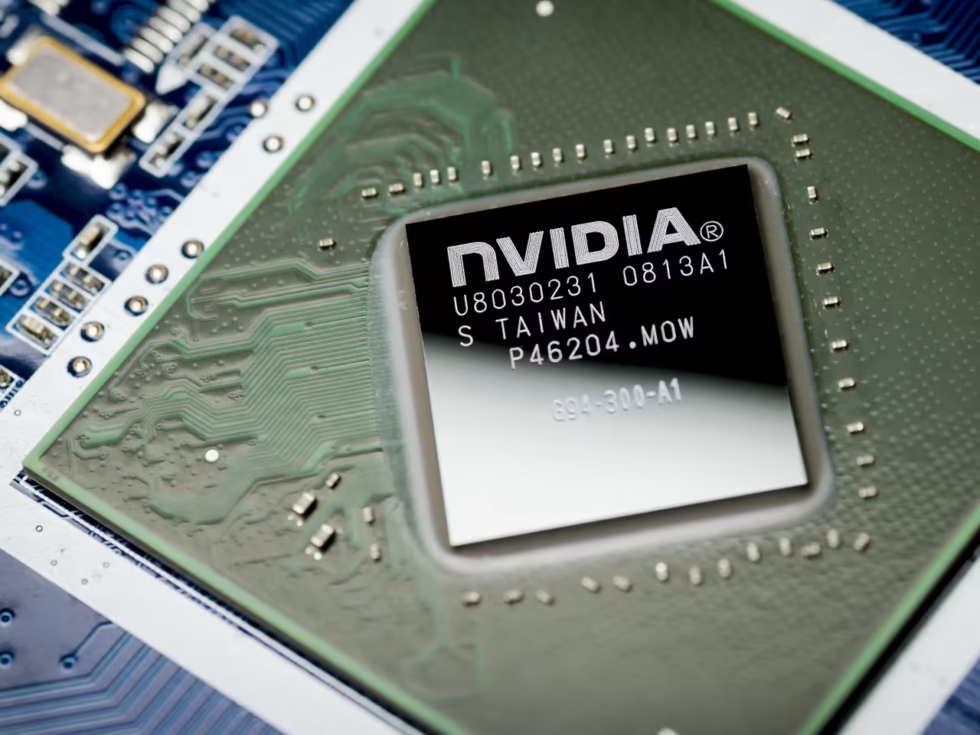
Nvidia has reinforced its leadership in artificial intelligence by confirming that its next-generation Rubin chips are progressing as planned, with expectations that they will significantly accelerate AI computing capabilities. The announcement highlights the company’s continued focus on innovation at a time when global demand for AI-driven technology is rapidly expanding across industries.
The Rubin chips are designed to deliver major improvements in speed and efficiency, addressing the growing computational demands of advanced AI models. As artificial intelligence systems become more complex, the need for faster data processing and lower energy consumption has become critical. Nvidia’s latest developments aim to meet these challenges while maintaining reliability at scale.
According to company leadership, the Rubin platform represents a key step in Nvidia’s long-term roadmap. The chips are expected to support data centers, cloud computing providers, and enterprises developing large AI models. Faster processing speeds could enable quicker training times, more responsive applications, and broader adoption of AI across sectors such as healthcare, finance, automotive technology, and scientific research.
The announcement also reflects Nvidia’s strategic response to intensifying competition within the semiconductor industry. As rivals invest heavily in AI-focused hardware, Nvidia continues to emphasize performance leadership and ecosystem integration. Its chips are not only built for raw speed but also optimized to work seamlessly with software tools widely used by developers and researchers.
Beyond performance gains, the Rubin chips are expected to improve energy efficiency, a growing concern for large-scale data centers. Lower power consumption can reduce operational costs and environmental impact, making advanced AI systems more sustainable. This aspect is increasingly important as governments and corporations place greater emphasis on energy responsibility.
Market observers view the progress of the Rubin chips as a positive signal for Nvidia’s future growth. Strong execution on product development can help the company maintain its position at the center of the AI boom. As businesses race to integrate AI into operations, reliable and high-performance hardware remains a critical foundation.
In conclusion, Nvidia’s confirmation that its Rubin chips are on track underscores the company’s confidence in its technology strategy. By focusing on speed, efficiency, and scalability, Nvidia continues to shape the future of artificial intelligence infrastructure. If development stays on schedule, the new chips could play a pivotal role in powering the next wave of AI innovation worldwide.