


Strait of Hormuz Ships Keep Moving Despite Blockade, Leaving Markets Uncertain
A blockade announced by the United States in the Strait of Hormuz was expected to disrupt global oil supply, but reality is telling a different story.
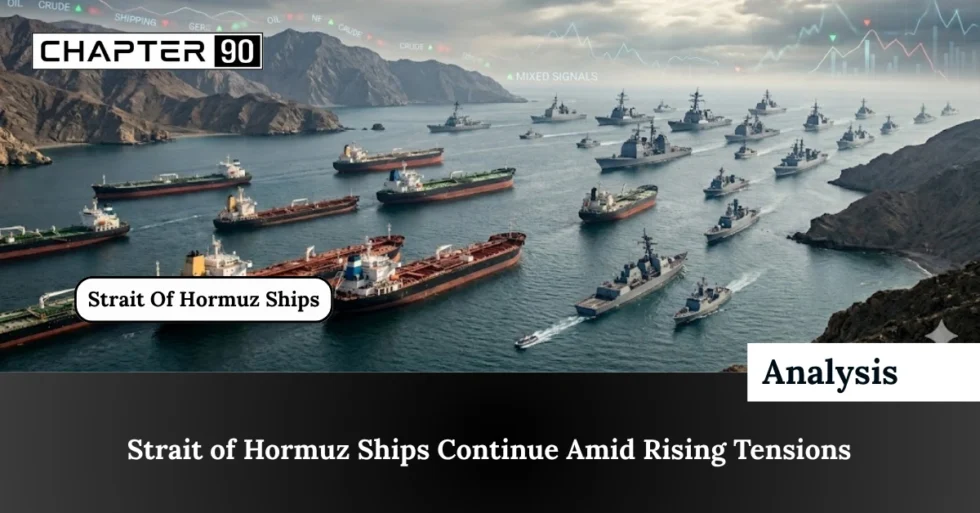
Even as tensions rise, Strait of Hormuz ships are still crossing key routes, highlighting a clear contradiction between geopolitical headlines and actual market activity.
This gap between expectation and reality is now becoming the main driver of uncertainty.
What Happened: Ships Cross Despite Restrictions
At least two Strait of Hormuz ships successfully crossed the waterway after stopping at Iranian ports, despite the blockade announcement.
The movement suggests that restrictions are not being fully enforced or are facing practical limitations on the ground.
This development challenges the assumption that oil flows would immediately halt.
Why This Matters for Oil Markets
The continued movement of Strait of Hormuz ships shows that the blockade is not yet fully effective.
Oil supply has not been completely disrupted, which means the market is receiving mixed signals. On one hand, there is geopolitical tension. On the other hand, physical supply is still moving.
This creates a complex situation where traders cannot clearly price risk, making market direction harder to predict.
Market Impact: Uncertainty Drives Volatility
Because the Strait of Hormuz ships are still moving, oil prices are not reacting in a straightforward way.
Instead of a sharp spike, markets are fluctuating as traders try to interpret conflicting signals. This has increased volatility across energy markets.
Investors are now caught between fear of escalation and evidence that supply is still functioning.
Bigger Picture: Tension Without Full Disruption
The situation highlights a key reality: geopolitical tension remains high, but actual disruption has not fully materialized.
Military and political moves may signal escalation, but real world supply chains often operate differently, especially in complex regions like Hormuz.
Final Take
The current scenario shows that markets are being driven as much by perception as by reality.
The situation shows that while geopolitical moves grab headlines, actual supply dynamics are far more complex.
Understand the Key Drivers Behind Today’s Financial Headlines