



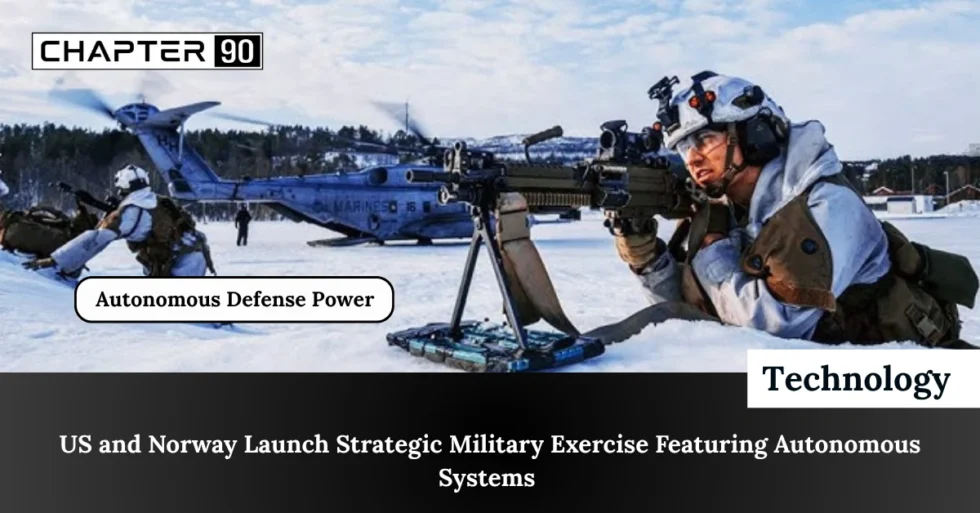
US and Norway Boost Arctic Defense with Robotic Exercise
The United States Navy and Norway are strengthening their military cooperation in the Arctic through a large-scale unmanned systems and explosive ordnance disposal exercise taking place from May 4 to May 24, 2026. The joint operation focuses on deploying advanced Robotics and Autonomous Systems (RAS) in the High North, one of the world’s most demanding maritime regions.
The exercise is designed to improve defense readiness and enhance both countries’ ability to secure critical maritime areas in harsh Arctic conditions.
Advanced Unmanned Technology Tested in Harsh Arctic Conditions
The training marks one of the first major efforts to rapidly deploy advanced unmanned systems in the challenging Arctic environment. U.S. Navy expeditionary forces are operating alongside Norwegian forces to test how autonomous technologies perform in extreme cold-weather conditions.
The exercise includes the use of unmanned surface vessels (USVs) and unmanned underwater vehicles (UUVs) capable of carrying out surveillance, reconnaissance, and defensive missions. Military officials believe these technologies could play a major role in future naval operations worldwide.
Focus on Maritime Security and Undersea Protection
The joint mission between Commander Task Force 66 and Commander Task Force 68 is aimed at strengthening several key defense capabilities. These include mine countermeasures, protection of critical undersea infrastructure, and improving maritime domain awareness.
The operation also focuses on intelligence gathering and surveillance missions in remote Arctic waters. Norwegian forces are contributing their extensive regional knowledge and cold-weather operational experience to support the training effort.
US Navy Highlights Importance of Autonomous Warfare Systems
Vice Adm. J.T. Anderson, commander of the U.S. 6th Fleet, described the deployment as a major step forward for military innovation. He stated that the exercise demonstrates how advanced unmanned systems can operate effectively even in some of the world’s harshest maritime environments.
According to Anderson, the use of sophisticated surface and underwater autonomous vehicles provides a critical defensive advantage and showcases the growing role of unmanned technology in modern naval warfare.
Norway Emphasizes Arctic Security and Surveillance
Norwegian military officials stressed the importance of strengthening Arctic security through cooperation with allied forces. Commodore Kyrre Haugen of the Royal Norwegian Navy said the exercise improves both surveillance and defense capabilities in the region.
By combining advanced autonomous technology with Norway’s experience in Arctic operations, the two nations aim to improve situational awareness and better protect strategic maritime infrastructure.
High-Tech Naval Systems Deployed During Exercise
During the operation, U.S. Navy personnel are testing advanced unmanned vessels from Ramsund in Norway. Among the technologies being used are the high-speed Global Autonomous Reconnaissance Craft (GARC) and the long-endurance Lightfish unmanned surface vessel.
These systems are being evaluated for their ability to conduct operations in difficult areas such as Arctic fjords and remote coastal regions. Officials say the testing will help determine how unmanned systems can support future maritime security missions.
Explosive Ordnance Teams Address Historical Threats
The exercise also includes cooperation between U.S. and Norwegian explosive ordnance disposal divers. Teams equipped with advanced dive gear and underwater autonomous systems are working together to locate and safely neutralize old explosive devices left behind from World War I and World War II.
These underwater hazards continue to pose risks to commercial and military vessels operating in the region. It making their removal an important part of maritime safety efforts.
Strengthening Long-Term Arctic Defense Partnerships
Captain Jeremy Wheat, commander of Task Force 68, said the exercise represents an important step in developing future Arctic defense operations. He emphasized that autonomous systems are no longer experimental concepts but are now becoming central to military strategy and maritime security.
Officials from both countries believe the lessons learned during the exercise will help shape. How allied naval forces operate in the Arctic for years to come.
US 6th Fleet Expands Autonomous Warfare Capabilities
The operation also reflects the broader mission of the U.S. 6th Fleet to integrate robotic and autonomous systems into naval operations. Task Force 66, established in 2024 and based in Naples, Italy, focuses on maritime surveillance, counter-drone operations, and advanced expeditionary warfare strategies.
Meanwhile, Task Force 68, headquartered in Spain, oversees expeditionary combat operations across Europe and Africa, helping bridge the gap between naval and shore-based military missions.
Arctic Exercise Signals Future of Naval Operations
The joint Arctic exercise between the United States and Norway highlights. The growing importance of unmanned technologies in modern defense strategy. As geopolitical focus on the Arctic increases, both countries are investing in advanced systems. It can improve surveillance, security, and operational effectiveness in difficult environments.
The operation demonstrates how international military partnerships and emerging technologies are reshaping the future of naval warfare and Arctic security.