


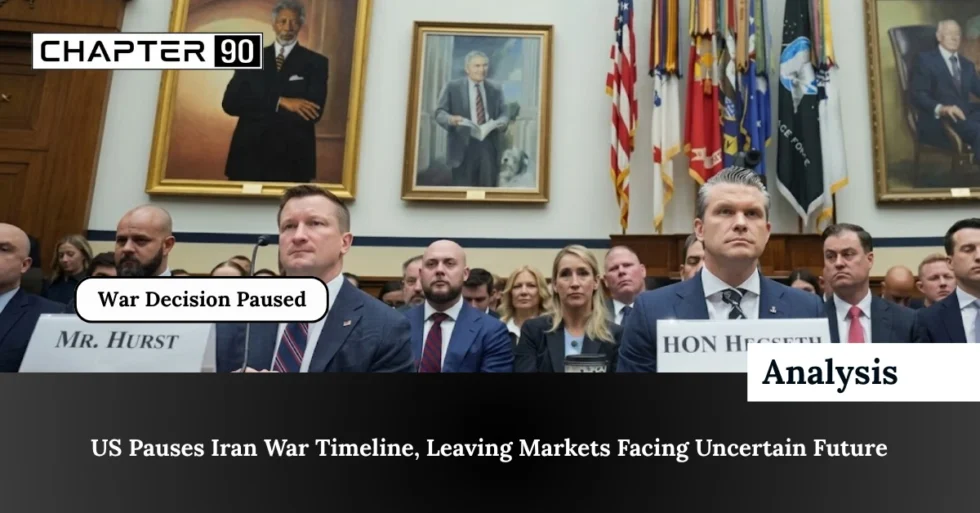
Iran War Approval Delay Signals Rising Uncertainty for Markets and Oil Prices
US Pauses Key Decision on Iran Conflict
The Iran war approval delay is adding a new layer of uncertainty to global markets after Pete Hegseth indicated that the timeline for seeking formal approval has been paused.
This move shifts expectations around potential escalation and creates a more complex outlook for investors.
What Happened: Timeline for War Decision Halted
The Iran war approval delay means that a previously expected deadline for authorizing further military action is no longer active.
Instead of a clear decision point, policymakers are extending the window, leaving the situation open-ended.
Expected action → delay → uncertainty increases
Past Context: Rising Tensions and Market Sensitivity
Tensions involving Iran have been building over time, particularly around strategic locations like the Strait of Hormuz, a critical route for global oil shipments.
Markets have reacted sharply to every development, making the Iran war approval delay highly significant.
Core Reason: Strategic Caution and Political Complexity
The main driver behind the Iran war approval delay is a combination of military caution and political calculation.
immediate escalation
Assess geopolitical risks
Manage domestic and international pressure
This is not a retreat, it is a pause to reassess strategy under high uncertainty.
Power Players Influencing the Situation
The Iran war approval delay is shaped by key decision-makers:
- Pete Hegseth → communicating policy direction
- US leadership → controlling military decisions
- Iran → responding to pressure
- Global allies → influencing diplomatic outcomes
These actors determine whether tensions escalate or stabilize.
Market and Economic Impact
The Iran war approval delay has direct implications for global markets:
- Oil prices remain volatile due to uncertainty
- Energy companies face unpredictable conditions
- Inflation risks rise if supply disruptions occur
- Investors adopt cautious positioning
Uncertainty → volatility → risk premium increases
What This Means Going Forward
The Iran war approval delay creates multiple scenarios:
- De-escalation → stabilizes markets and lowers oil prices
- Prolonged tension → keeps volatility elevated
- Sudden escalation → sharp spikes in energy costs
Markets will closely track geopolitical signals.
Where This Is Heading
The Iran war approval delay highlights how geopolitical decisions directly shape economic outcomes.
In today’s environment, uncertainty itself becomes a driver of market behavior.
Because when conflict decisions are paused, markets don’t relax; they prepare for multiple outcomes at once.