


US Stock Market Iran Tensions Show Unusual Strength Despite Oil Shock and War Risks
Markets Climb Even as Geopolitical Risk Intensifies
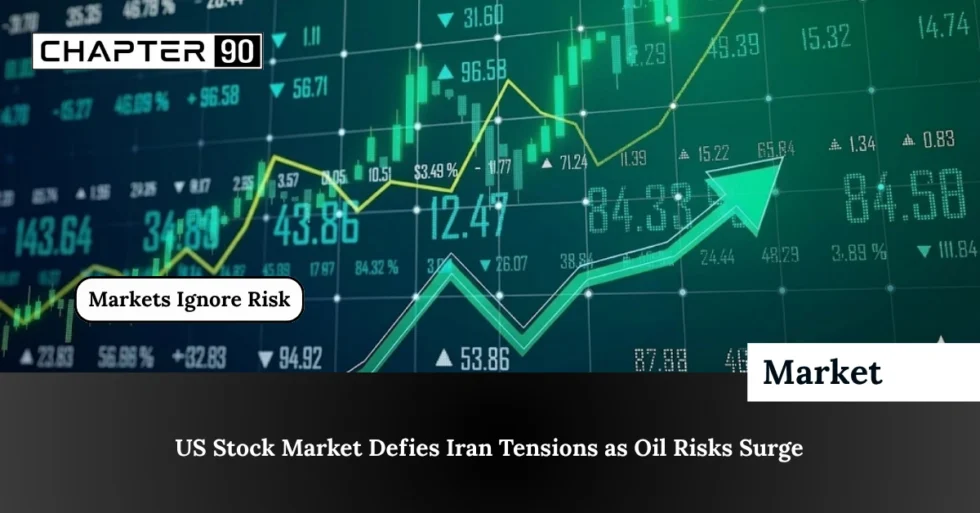
The US stock market Iran tensions narrative is developing in a way that is not following the usual script.
Wall Street ended higher, with the S&P 500 gaining around 0.4%, the Nasdaq rising 0.5%, and the Dow also adding roughly 0.4%, even as tensions between the United States and Iran continue to escalate.
At the same time, oil prices remain elevated due to fears around supply disruption through the Strait of Hormuz, creating a rare situation where risk and optimism are moving together.
What Happened: Ceasefire Hopes vs Escalation Threats
The market reaction to Iran tensions has been driven by two conflicting forces.
On one side, reports suggest that mediators are attempting to negotiate a temporary ceasefire between the US and Iran. On the other hand, Donald Trump has issued a strict deadline for Iran to reopen the Strait of Hormuz, warning of severe consequences if the demand is not met.
Iran has resisted immediate compliance, keeping uncertainty elevated. Despite this, equities continued to rise, showing that investors are not fully pricing in a worst-case scenario yet.
Background: Why the Strait of Hormuz Drives Global Markets
To understand the US stock market Iran tensions, it is important to recognize the strategic importance of the Strait of Hormuz.
Roughly 20% of global oil supply passes through this narrow waterway, making it one of the most critical chokepoints in the global economy.
Any disruption here does not just impact oil prices; it affects inflation and central bank decisions, transportation costs, and overall economic stability.
This is why even a small escalation in this region sends shockwaves across financial markets.
The Real Reason Markets Are Holding Up
What’s interesting here is that markets are not reacting with panic, and that tells us something important.
Investors appear to be pricing in a limited conflict scenario, rather than a prolonged or full-scale disruption.
In practical terms, this means markets are assuming:
- Oil supply disruptions will be temporary
- Diplomatic pressure will eventually lead to a resolution
- Economic fundamentals in the US remain strong
According to analysts, equities are still only about 5–6% below their all-time highs, suggesting confidence has not collapsed despite rising risks.
This is not fear-driven trading; it is expectation-driven positioning.
Power Players Quietly Shaping Market Direction
This situation is not just about headlines; it is being driven by strategic decisions from key players:
- Donald Trump, shaping geopolitical risk through aggressive deadlines
- The Iranian leadership, controlling access to a critical energy route
- OPEC, monitoring supply and pricing dynamics
- Institutional investors, adjusting portfolios based on probability, not panic
Interestingly, defense-related stocks have begun to show relative strength, signaling that some investors are quietly hedging against escalation while still maintaining broader equity exposure.
Market Impact: Oil, Inflation and Sector Rotation
The impact of US markets amid Iran tensions is becoming more visible across asset classes.
- Oil prices rising → increasing inflation pressure
- Bond yields reacting to uncertainty
- Equity markets are showing resilience, but with rotation
This is creating a split market environment:
Energy stocks are benefiting from higher oil price
Technology is holding up due to earnings strength
Defensive sectors are gaining attention as hedges
This tells us something important:
Markets are not ignoring risk; they are redistributing it strategically
An Overlooked Signal: Stability in Consumer Data
One key reason equities are holding up is that US economic data remains stable.
Consumer spending has not yet shown signs of stress, and the labor market continues to remain relatively strong.
This creates a buffer effect.
Even with rising oil prices, investors believe the broader economy can absorb short-term shocks at least for now.
What Happens Next Depends on Oil and Diplomacy
The next phase of the US stock market Iran tensions will depend on two key triggers:
- Whether the Strait of Hormuz reopens smoothly
- Whether tensions escalate into direct conflict
Possible scenarios:
- Ceasefire agreement → markets rally further
- Escalation → oil spikes above $100+, equities drop sharply
- Ongoing uncertainty → volatile sideways movement
Right now, markets are balanced between these outcomes.
Conclusion
The US stock market and Iran tensions situation reveals something deeper about modern financial markets.
Investors are no longer reacting instantly to geopolitical risk; they are calculating probabilities.
Right now, the dominant belief is that tensions will remain controlled.
But that confidence is fragile.
If that assumption breaks, market reaction could be fast and aggressive.
Editor’s Insight
Markets are not calm; they are calculated. Investors are holding risk positions because they believe escalation will be avoided. The moment that belief shifts, the downside could be sharp.
Stay Ahead of Global Market Movements and Investor Sentiment