



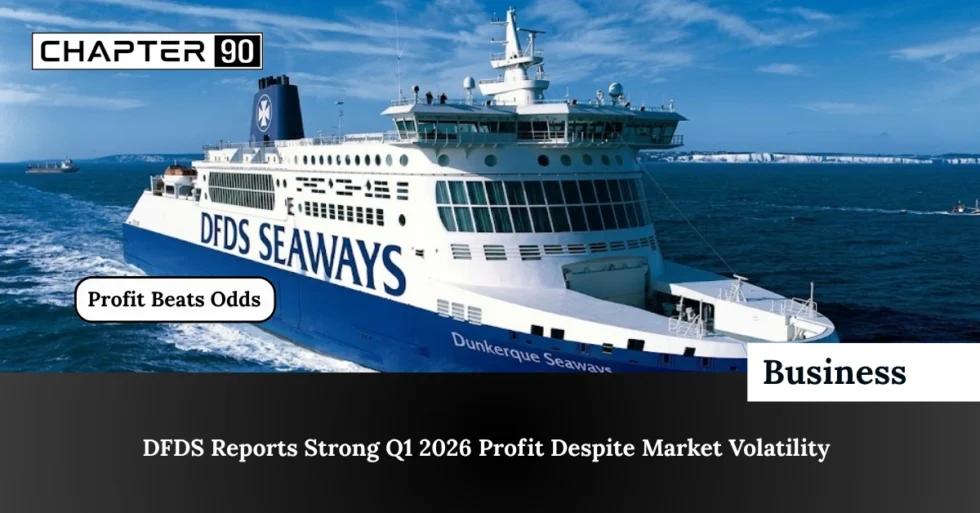
DFDS Q1 2026 Results Show Performance Gains Amid Revenue Decline
DFDS returned to profitability in the first quarter of 2026, reporting DKK 33 million in operating profit despite a 2 percent decline in revenue. The results highlight strong cost control and operational discipline in a volatile European logistics market shaped by rising fuel prices and geopolitical uncertainty.
As one of Europe’s leading ferry and logistics operators, DFDS’s performance is widely seen as a key indicator of regional trade activity and supply chain stability.
DFDS Q1 2026 Profit Growth Explained
DFDS reported total revenue of DKK 7.353 billion, approximately $1.15 billion, for Q1 2026, marking a slight decline compared to the same period last year.
Despite this, operating profit reached DKK 33 million, a sharp turnaround from a loss of DKK 117 million in Q1 2025. This shift reflects improved financial discipline and a stronger focus on profitability over expansion.
The results show that companies can restore profitability even when revenue growth remains under pressure, particularly in industries exposed to external cost shocks.
Why DFDS Revenue Declined Despite Profit Rise
The revenue decline was primarily driven by softer trade demand and fluctuations in freight volumes across certain European routes.
However, DFDS successfully offset this pressure through targeted cost-cutting measures, route optimization, and improved capacity utilization across its ferry and logistics network.
These operational adjustments allowed the company to protect margins and maintain financial stability, even as top-line growth slowed.
Industry analysts note that logistics firms across Europe are increasingly prioritizing efficiency and cost control due to ongoing economic uncertainty and fuel price volatility.
Leadership Strategy Driving Performance
According to CEO Karen D. Boesen, both business divisions contributed to the improved performance through disciplined financial management and stronger operational execution.
The ferry division benefited from steady freight demand, particularly across Mediterranean routes, while the logistics division delivered stable performance in continental Europe and Nordic markets.
This balanced contribution across segments highlights the importance of diversification in managing risk within volatile global markets.
Impact on European Logistics and Trade
DFDS’s performance reflects broader trends in the global logistics and transport sector.
Rising fuel costs, partly influenced by tensions in the Persian Gulf region and decisions from OPEC, have increased operational expenses across the industry.
At the same time, global trade demand remains uneven, with some regions experiencing resilience while others face slowdown pressures.
For investors, DFDS’s return to profitability signals that companies capable of adapting quickly to cost pressures and market shifts are better positioned to navigate ongoing volatility.
Financial Strength and Cash Flow Improvement
Beyond operating profit, DFDS reported strong improvements in cash flow and financial structure.
The company generated adjusted free cash flow of DKK 300 million. Its approximately $47 million, indicating improved liquidity and better capital management.
Its debt-to-earnings ratio improved to 3.9 times, moving closer to its target of maintaining levels below 4.0 times. This strengthens the balance sheet and provides flexibility for future strategic decisions.
However, fuel price volatility remains a key risk factor that could influence cost structures in upcoming quarters.
DFDS 2026 Outlook and Market Risks
Looking ahead, DFDS has maintained its full-year operating income forecast, expecting earnings between DKK 1 billion and DKK 1.4 billion.
The company has also upgraded its free cash flow outlook, projecting more than DKK 250 million for the year.
Despite this confidence, risks remain tied to fuel price fluctuations, geopolitical tensions, and changes in global trade demand.
DFDS is expected to continue focusing on cost discipline, operational flexibility, and strategic adjustments to manage these uncertainties.
Conclusion: Efficiency Becomes the New Growth Driver
DFDS’s Q1 2026 performance reflects a structural shift in the global logistics industry.
Profitability is no longer driven solely by revenue growth but increasingly by efficiency, cost control, and resilience under pressure.
As global markets remain unpredictable. The companies that can adapt quickly and manage costs effectively are likely to define the next phase of growth in the transport and logistics sector.
For more global market insights and breaking business news, visit our homepage