


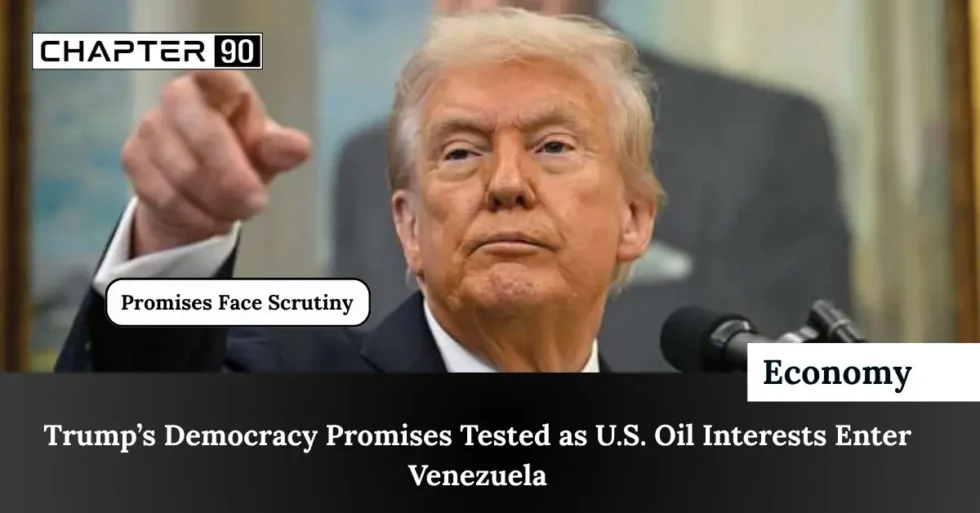
U.S. Oil Expansion in Venezuela Raises Questions Over Democratic Reform
The United States is expanding energy engagement with Venezuela as American companies explore new oil and mining opportunities under interim President Delcy Rodríguez. The shift is raising questions about whether economic stabilization is taking priority over democratic reforms and election commitments.
The strategy reflects growing U.S. interest in Venezuela’s energy resources at a time when global oil markets remain sensitive to geopolitical disruptions and supply concerns.
“Drill Baby Drill” Highlights Shift in Energy Relations
When National Energy Dominance Council Executive Director Jarrod Agen recently visited Caracas, he reportedly signed a guest book using President Donald Trump’s slogan “Drill Baby Drill.”
Agen later described the visit during the POLITICO Energy podcast, calling it part of a broader transformation in U.S.–Venezuela relations.
The developments follow major political changes in Venezuela earlier this year, which reshaped the country’s leadership structure and reopened discussions around foreign investment.
United States Encourages Energy Investment
U.S. officials have traveled repeatedly between Washington and Caracas to support discussions surrounding oil production, mining projects, and infrastructure investment.
Reuters reported that the United States removed sanctions on Rodríguez in April 2026, opening the door to renewed diplomatic and commercial engagement.
The Trump administration has encouraged increased energy cooperation as global markets continue responding to geopolitical instability and supply disruptions linked to conflicts involving Iran and other major oil-producing regions.
Critics Question Delayed Democratic Progress
Despite growing economic cooperation, critics argue that democratic reforms in Venezuela remain unclear.
Rodríguez has indicated that elections are expected in the future but has not provided a specific timeline for a nationwide vote.
Some political analysts and opposition groups fear that expanding energy partnerships before establishing clear democratic commitments could reduce pressure for political reform.
Others argue that stabilizing Venezuela’s economy may be necessary before elections and broader institutional changes can take place.
Economic Stabilization Becomes Immediate Priority
According to Agen, the administration is currently focused on what officials describe as a “stability phase,” prioritizing economic recovery and energy sector investment.
Discussions between U.S. representatives and Venezuelan officials have reportedly centered on rebuilding infrastructure, increasing oil production capacity, and encouraging private-sector participation.
Supporters of the strategy argue that economic stabilization could eventually support political normalization and reduce long-term instability.
American Energy Companies Show Growing Interest
Interest from U.S. energy companies has increased following the easing of sanctions and the reopening of investment discussions.
Several firms, including Hunt Oil, HKN Energy, and Crossover Energy, are evaluating opportunities in Venezuela’s oil sector.
Industry executives believe Venezuela’s large untapped oil reserves could attract substantial long-term investment if political and legal conditions improve.
Legal Risks and Political Uncertainty Continue
Despite renewed optimism, many investors remain cautious due to Venezuela’s history of political instability and foreign asset nationalization.
Legal experts warn that concerns surrounding contract enforcement, property rights, and long-term regulatory stability could continue affecting investor confidence.
Energy analysts also note that large-scale investment may remain limited unless stronger governance structures and clearer political direction emerge.
Opposition Groups Continue Calling for Elections
Venezuelan opposition groups continue advocating for transparent elections and democratic reforms as part of any long-term recovery strategy.
Some opposition figures argue that economic growth alone cannot fully stabilize the country without broader institutional reform and public trust in the political system.
The debate reflects a broader international discussion about whether economic engagement can successfully encourage democratic transition.
Global Energy Markets Closely Monitor Venezuela
Energy markets are closely watching developments in Venezuela because the country holds some of the world’s largest oil reserves.
Any major increase in Venezuelan oil production could influence global supply levels, energy prices, and broader geopolitical dynamics.
The situation has become increasingly important as governments and energy companies search for ways to stabilize supply amid ongoing global uncertainty.
Conclusion: Energy Expansion Brings Opportunity and Political Questions
The expansion of U.S. energy engagement in Venezuela represents a significant geopolitical and economic development.
While increased investment could support economic recovery and strengthen global energy supply, questions surrounding democratic reform, elections, and political stability remain unresolved.
How Venezuela balances economic reopening with democratic transition may ultimately determine the long-term success of both its political recovery and its renewed relationship with the United States.
Read more global energy and political updates on our homepage